 blog
blog
Why Directors Need Professional Pitch Decks
Table of Contents
- Why Directors Need Professional Pitch Decks to Secure Funding
- How to Create a Film Pitch Deck That Wins Stakeholders
- Pitch Deck Design for Filmmakers: Balancing Aesthetics and Clarity
- Film Financing Pitch Deck: Legal and Compliance Considerations
Why Directors Need Professional Pitch Decks
Last Updated: July 26, 2026
Why Directors Need Professional Pitch Decks to Secure Funding
A professional pitch deck is a strategic tool that transforms your creative vision into a compelling business case stakeholders can understand and act on. The Moon Unit has watched hundreds of directors present their work, and the difference between those who secure the work and those who don't often comes down to presentation quality.
According to research on investor decision-making patterns, decision-makers spend an average of 3-5 minutes evaluating pitch materials. In that window, a professional deck establishes credibility; an amateur one signals you're not serious about your project. Professional pitch decks give your story a visual anchor and create a document that circulates after you leave the room, still working for you.
How to Create a Film Pitch Deck That Wins Stakeholders
Building a film pitch deck that converts requires understanding what stakeholders seek: your ability to execute, manage risk, and deliver return on investment. Balance creative storytelling with hard business logic.
Open with a hook, a single image, logline, or question that makes the viewer lean in. Your executive summary should answer: What is this project? Why does it matter? Who is your audience? What's the budget and timeline? What's the ask? Pitch deck best practices from venture capital firms emphasize that clarity separates fundable projects from interesting ideas.
Establish the problem or opportunity next. Why does this story need to exist now? Reference comparable films, audience demographics, or cultural moments that validate demand.
Present your solution using aggressive visuals, mood boards, storyboard frames, color palettes, casting ideas. Let images do the work rather than lengthy descriptions.
Your team slide is critical. Investors fund people first, projects second. Highlight your director's track record, producer's experience, and line producer's budget management ability. Include market analysis identifying your target audience and comparable box office or streaming performance. Budget and timeline slides should demonstrate you've done the work. Close with a clear ask: how much money, what it's for, what milestones it unlocks, and your distribution path.
Pitch Deck Design for Filmmakers: Balancing Aesthetics and Clarity
The visual design must reflect your film's aesthetic without overwhelming content.
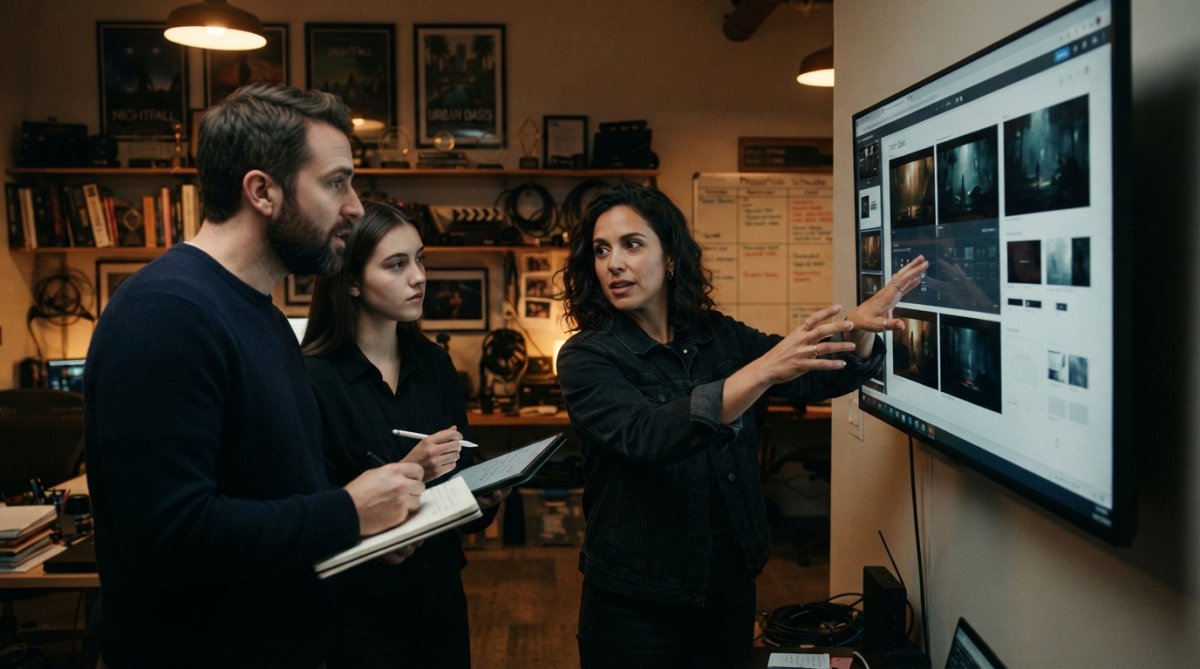
Choose 2-3 primary colors aligned with your film's visual identity and use them consistently. Select one sans-serif font for headers and one for body text, oversized decorative fonts reduce readability.
White space is essential. A slide with one powerful image and three lines of text communicates better than a cluttered one. Use high-quality images throughout. If pitching a feature film, use actual footage from your proof-of-concept or short film. If early in development, use mood boards and reference images that convey tone and style.
Simple data visualization works best. A bar chart comparing box office performance of comparable films is clearer than complex multi-category pie charts. Avoid animation and transitions, they distract and date your deck. One slide per minute is a good rule. A 15-minute pitch should have roughly 15 slides, forcing you to cut filler and focus on essentials.
Film Financing Pitch Deck: Legal and Compliance Considerations
Presenting to potential investors involves legal and regulatory considerations that protect both you and your stakeholders.
Clarify the nature of your pitch. Are you presenting to accredited investors? Are you seeking equity investment, debt financing, or grant funding? The legal framework differs significantly. SEC guidance on investment offerings defines accredited investors and outlines disclosure requirements. Consult with a securities attorney before pitching.
Avoid forward-looking statements that could trigger regulatory scrutiny. Use qualified language: "Based on comparable films, we project box office revenue in the range of X to Y." Include disclaimers clarifying the speculative nature of financial projections.
Ensure you have licenses or permissions for any music, images, or footage from other creators. Establish a clear confidentiality policy: who gets the deck, under what conditions, and with what expectations. Document this in writing.
Include a disclaimer slide: "This presentation contains forward-looking statements based on current expectations. Actual results may differ materially. This is not an offer to sell securities. Any investment will be made pursuant to definitive agreements and legal documentation."
Consideration | Action | Timing |
|---|---|---|
Investment type clarification | Consult securities attorney | Before first pitch |
Forward-looking statements | Use qualified language and disclaimers | In deck and verbal pitch |
IP licensing | Secure licenses for music, images, footage | Before sharing deck |
Confidentiality agreements | Establish clear NDA policy | Before distribution |
Institutional requirements | Research investor requirements | Before targeting specific funds |
Financial projections | Document assumptions and methodology | Before pitching |
Working with The Moon Unit on your pitch deck ensures your creative presentation aligns with professional standards for investor communication. With more than 8,000 pitches across 40 countries behind them, the team understands both the creative and business sides of what makes a deck work, along with the legal and compliance frameworks that govern the pitching process.
A professional pitch deck transforms your film from an idea into a fundable project. It tells your story clearly, establishes credibility, and gives investors the information they need to say yes. The Moon Unit specializes in crafting pitch decks that balance bold creative vision with clear business logic, helping directors secure the funding and support they need to make their films.
Frequently Asked Questions
What is the purpose of a pitch deck for a film director?
A professional pitch deck communicates your creative vision, business model, and market opportunity to investors, producers, and stakeholders. It translates your storytelling into a structured narrative that demonstrates traction, growth potential, and scalability. Beyond securing capital, it establishes your competitive advantage and clarifies your target market, making it essential for stakeholder communication and investor relations.
How does a professional pitch deck help a director secure funding?
Professional pitch decks leverage visual hierarchy, strategic storytelling, and data-driven insights to build trust and persuade investors. They present your value proposition clearly, outline revenue projections, and showcase problem-solution fit. A well-designed deck reduces due diligence friction, demonstrates product-market fit, and positions you as credible and prepared—all factors that influence investor decision-making and capital raising success.
What elements should a film pitch deck include?
Essential slides include an executive summary, problem statement, your solution and creative approach, target market analysis, competitive advantage, traction metrics, business model, revenue projections, team credentials, funding requirements, and a clear call to action. Each slide should reinforce your narrative arc, visual storytelling, and ROI potential. The deck should balance compelling visuals with substantive content that addresses investor concerns about scalability and exit strategy.
How does pitch deck design impact your chances of winning funding?
Visual design and layout directly influence how investors perceive your professionalism and credibility. A thoughtfully designed deck—with consistent branding, clear visual hierarchy, and cinematic aesthetics appropriate to your industry—enhances storytelling impact and information retention. Poor design signals carelessness and undermines your message, while professional design reinforces trust, demonstrates attention to detail, and makes your pitch deck examples memorable in a crowded investor landscape.
This article was written using GrandRanker