 how-to
How to Present Creative Concepts: Win the Room
Table of Contents
- How to Present Creative Concepts That Resonate
- Building a Creative Presentation Script Template
- Creating Compelling Creative Concept Deck Examples
- How to Handle Client Feedback on Creative Work
Last Updated: August 3, 2026
How to Present Creative Concepts That Resonate
The best idea in the room doesn't always win. The best-told idea does.
Every creative concept has a graveyard, decks that never got greenlit, ideas that died in the Q&A, visions that made perfect sense in your head and landed flat in the room. The difference between those and the ones that stuck wasn't the quality of the thinking. It was the quality of the telling.
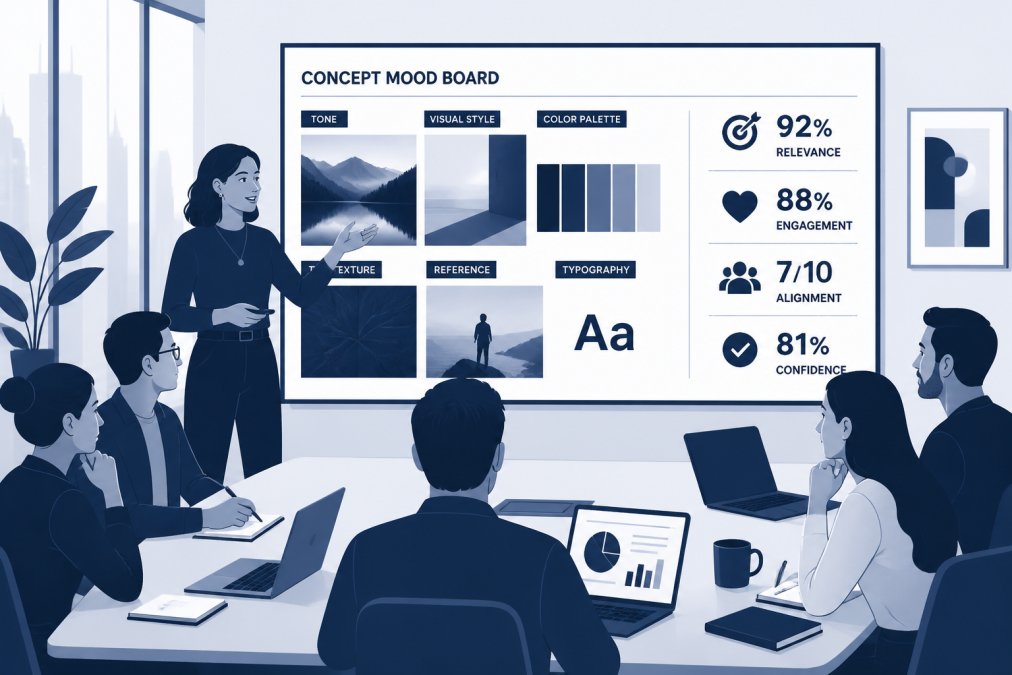
Your stakeholders need two things at once: to feel something, and to believe it will work. That's the tension at the heart of every creative presentation and learning to hold both is what separates the teams that move projects forward from the ones that keep going back to the drawing board.
The good news: this isn't a talent. It's a structure.
The most effective creative presentations follow a single narrative arc: problem, insight, concept, proof, call to action. Master that arc, and you don't just present ideas. You make them inevitable.
Building a Creative Presentation Script Template
Imagine the script as a spine. It's not there to be recited word for word. It's there to keep you upright while leaving your hands free to actually connect with the room.
Opening (30 seconds): State the problem or brief in your own words. Show you understand what success looks like.
The Insight (45 seconds): Share the human truth your concept taps into. This is where emotional connection happens.
The Big Idea (60 seconds): Present your concept with visual support. Lead with what makes it different.
Design Rationale (60 seconds): Justify every major creative choice. Why this music? Why this color palette? Why this structure? Connect each choice back to the brief and audience.
Feasibility & Timeline (30 seconds): Address the practical side. Budget, crew, locations, timeline.
Call to Action (20 seconds): Close with what you need next: approval, feedback, budget sign-off, or revision direction.
Build in pauses. After you present the big idea, stop. Let it land. Silence gives stakeholders space to react and imagine.
Creating Compelling Creative Concept Deck Examples
Your presentation deck is the visual proof of your concept. Follow one principle: one idea per slide, maximum.
Slide 1 - Title & Problem: Project name, brief summary, core challenge.
Slide 2 - Audience Insights: Who are we reaching? What do they care about?
Slide 3 - The Big Idea: Your hero slide. One powerful visual or headline that captures the concept in its simplest form.
Slide 4-5 - Visual Storytelling: Show mood boards, color palettes, reference imagery. Include storyboard sequences if pitching film.
Slide 6 - Design Strategy: Explain your choices. Connect design decisions to audience insights and objectives.
Slide 7 - Deliverables & Timeline: What you're making, when it ships, what resources you need.
Slide 8 - Next Steps: What approval or feedback do you need?
Show iteration. When you include early sketches alongside polished concepts, you signal that you've thought deeply about the work and can handle feedback.
The Psychology of Persuasion in Creative Pitches
How to present creative concepts isn't just about structure, it's about understanding what makes people say yes.

Establish credibility first. Before pitching your concept, prove you understand the brief, audience, and landscape. Reference competitive work. Audiences trust presenters who demonstrate knowledge.
Use specificity as proof. Vague concepts feel risky. Specific details, actual dialogue, exact visual references, and precise timelines make concepts feel inevitable.
Create tension and release. Build anticipation by stating the problem, then release it with your solution. The contrast makes the idea feel more powerful.
Appeal to identity, not just logic. Frame your concept as something that elevates the brand. "This positions you as a brand that understands your audience" is more persuasive than listing requirements.
Let your visuals breathe. Many presenters over-explain, assuming silence means confusion. In reality, silence often means people are thinking. The most persuasive presentations include moments of quiet confidence.
How to Handle Client Feedback on Creative Work
Presenting creative concepts continues when you finish talking. How you receive, process, and respond to feedback determines whether your ideas get made.
Listen without defending. When feedback comes, resist the urge to explain your choices. Listen fully. Write it down. Repeat it back: "So you're concerned the tone feels too edgy for the brand?" This signals you're taking feedback seriously.
Separate feedback from rejection. A stakeholder saying "I don't love the color palette" isn't rejecting the concept. It's a specific note on one element. Ask clarifying questions to keep the conversation constructive.
Distinguish between strategic feedback and preference. Some feedback is rooted in the brief and audience insights. Other feedback is personal taste. Both matter, but you need to know which is which.
Build iteration into your timeline. The best creative presentations include a revision round. Stakeholders feel more ownership when they've shaped the work through feedback.
Know when to push back gently. When feedback contradicts the brief, you can respectfully challenge it: "That note is interesting. Here's why we made the opposite choice based on the audience insight we discussed earlier."
Feedback Type | How to Respond | Next Step |
|---|---|---|
Strategic (rooted in brief/audience) | Acknowledge, ask clarifying questions | Integrate into revision |
Preference-based (personal taste) | Listen, consider impact on brand | Evaluate against strategy |
Contradicts brief | Respectfully reference original objectives | Propose solution that honors both |
Unclear or vague | Ask specific questions | Get concrete direction before revising |
Requests major pivot | Understand timeline/resource impact | Discuss feasibility before committing |
Silence after a presentation is interesting. It doesn't always mean agreement. What happens when you ask directly, "What's your gut reaction?" You might be surprised what surfaces.
Remote presentations make this even more worth thinking about. People are less likely to speak up unprompted on a call than in a room. Building in deliberate pause time, inviting chat responses, and creating space for written feedback can shift the whole dynamic of what you hear back.
The gap between a concept that gets made and one that gets shelved is rarely about the idea. It's about whether the people in the room could see it clearly enough to say yes. When you bring structure, visual honesty, and genuine curiosity to how you present, you stop hoping they'll understand your vision. You make it hard for them not to.
Frequently Asked Questions
What's the best way to structure a presentation when you have to present creative concepts to a skeptical client?
Start with the problem or brief, then reveal your big idea before diving into execution details. Lead with the emotional response you want, then back it up with design rationale and feasibility. Skeptical clients respond better when they understand the 'why' first. Use a narrative arc that builds tension and resolution, mirroring how the concept itself works. End with clear deliverables and next steps to reduce uncertainty.
How do I create a creative concept deck that actually wins approval?
A winning creative concept deck balances visual storytelling with strategic thinking. Include a clear problem statement, your big idea summarized in one sentence, mood boards that show visual direction, 2-3 mockups showing the concept applied, and a section justifying each design decision. Keep text minimal and let visuals dominate. Address project objectives and brand alignment explicitly. Use consistent visual identity throughout the deck so it feels intentional, not scattered.
How do I handle client feedback on creative work without losing the core concept?
Distinguish between constructive feedback (actionable, grounded in brief) and subjective preference (personal taste). When feedback arrives, ask clarifying questions: 'How does this affect the project objectives?' and 'What emotional response are you looking for?' Document feedback and propose iterations that honor the core idea while addressing legitimate concerns. If feedback conflicts with the brief, reference the original agreement. Iteration is normal; standing firm on strategy matters more than defending every detail.
What tools should I use when presenting creative concepts to different stakeholder groups?
For internal teams and tight deadlines, presentation software like Keynote or Google Slides with embedded mockups works well. For client pitches, interactive prototyping tools let stakeholders see the concept in motion. Mood boards and concept boards live best in design software where you can show the full visual system. For remote presentations, screen-sharing with live annotation keeps energy high. Choose tools that let you show work at multiple scales: big-picture strategy, then detailed execution, then specific deliverables.
This article was written using GrandRanker