 listicle
Branded Content Pitch Deck Examples 2026
Table of Contents
- What Makes a Branded Content Pitch Deck Stand Out
- Branded Content Proposal Template and Structure
- Best Practices for Branded Content Pitches
- How to Pitch Branded Content to Brands and Agencies
Last Updated: August 10, 2026
What Makes a Branded Content Pitch Deck Stand Out
A branded content pitch deck is your argument for why a brand should hire you, and in a full inbox, that argument has seconds to make itself. What separates a deck that lands the project from one that gets skimmed and forgotten usually comes down to three things: clarity in the storytelling, confidence in the visuals, and proof that you actually understand what the brand needs.
The strongest decks do three jobs at once: they show your creative vision, prove you understand the brand's audience, and make the case that you can execute on deadline. And specificity is what sets them apart. A generic deck talks about "authentic storytelling"; a winning one shows exactly how it'll get there, with reference footage, shot lists, colour palettes, and a clear production timeline.

Your deck doesn't have to be elaborate or trendy. It has to be clean enough that stakeholders focus on your ideas without distraction. A cluttered deck quietly signals you haven't worked out your information hierarchy, and that's a red flag for any brand weighing whether to trust you with their budget.
Branded Content Proposal Template and Structure
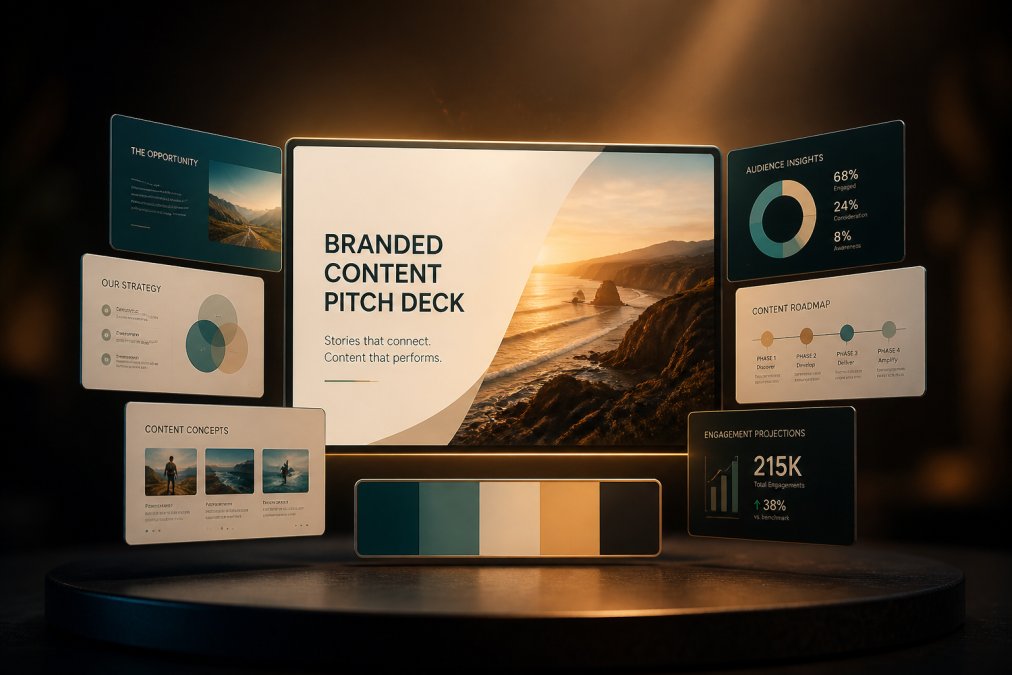
Your pitch deck should move from problem to solution to proof:
Opening / Hook (Slide 1-2): Start with the brand's challenge or opportunity, not your company name. A single powerful visual or question sets the tone.
Creative Concept (Slide 3-5): Describe your core idea in one sentence, then show it visually. Include reference footage, mood boards, or storyboard sketches. Brands need to see your vision.
Audience & Strategy (Slide 6-7): Who will watch this? Where will it live? How does it serve the brand's goals? Include platform specs, audience demographics, and distribution strategy.
Production Plan (Slide 8-10): Show timeline, budget breakdown, and team. Include shoot days, locations, post-production phases, and delivery dates. A vague timeline is a deal-breaker.
Case Studies / Previous Work (Slide 11-12): Show 2-3 similar examples with metrics if available. Prove you can deliver results.
Next Steps (Final Slide): End with a clear call to action. "We're ready to start pre-production on [date]. Here's what we need from you to move forward."
Section | Purpose | Length | Key Takeaway |
|---|---|---|---|
Opening | Establish understanding of brand challenge | 1-2 slides | You get it |
Creative Concept | Show your visual vision | 3-5 slides | Here's what it looks like |
Strategy | Prove strategic thinking | 2 slides | This serves your goals |
Production Plan | Build confidence in execution | 3 slides | We can deliver this |
Case Studies | Demonstrate capability | 2 slides | We've done this before |
Next Steps | Clear path forward | 1 slide | Let's make this happen |
Keep your deck to 12-16 slides maximum. Your goal is to create enough intrigue that the brand wants to schedule a call to dig deeper.
Best Practices for Branded Content Pitches
Lead with insight, not your company. Your first slide should address the brand's opportunity or challenge. This signals you're thinking about their needs.
Use reference footage strategically. Embed short clips (10-15 seconds each) directly into your deck to show exactly what visual language, pacing, and tone you're proposing.
Make the ask crystal clear. State plainly: "Investment: [details]. Timeline: [dates]. Deliverables: [list]." Brands respect straightforward communication.
Tailor the deck to the brand. A pitch for a luxury fashion brand looks different from one for a tech startup. Adjust your visual style and tone to match their aesthetic and values.
Include realistic production timelines. Build in contingency time for location scouts, weather delays, and post-production revisions. Brands trust producers who anticipate problems.
Show relevant previous work. If pitching a luxury automotive brand, include examples that match the tone, scale, and production quality you're proposing.
Keep design clean. Use consistent typography, a limited color palette, and white space. The visuals you're proposing should be the star, not the slide design.
How to Pitch Branded Content to Brands and Agencies
The pitch conversation matters as much as the deck itself.

Start with a question. Instead of "Here's our concept," try "What does success look like for this campaign?" This shows you're listening and thinking strategically.
Walk through the deck quickly. Hit key points, insight, concept, strategy, timeline, in 8-10 minutes. This leaves time for questions and conversation, where real decisions happen.
Anticipate objections. If your timeline is tight, explain why you can still deliver quality. Transparency builds trust.
Bring work samples on your laptop. You can adapt the conversation on the fly and pull up reference footage instantly if asked.
Close with a clear next step. "We're excited about this direction. If you'd like to move forward, we'll need [specific deliverables] by [date] so we can start pre-production on [date]."
Follow up within 24 hours. Thank them for their time, reiterate key points, and restate the timeline. Include a deck link in case they want to share it internally.
The branded content pitch deck is your first real conversation with a potential client. It has to prove three things: that you understand their brand, that you have a compelling vision, and that you can execute reliably. Get all three right, and the pitch stops being an act of persuasion and starts being a conversation about logistics.
When you're ready to move beyond templates and build a pitch that genuinely stands out, The Moon Unit crafts standout treatment designs and branded content pitch decks that elevate the narrative and carry stakeholders through your creative vision, drawing on more than 8,000 pitches across 40 countries. Whether you're pitching a commercial, a music video, or a branded content campaign, working with a creative partner who understands both storytelling and strategy takes the guesswork out of the process.
Frequently Asked Questions
What should be included in a branded content pitch deck?
A strong deck usually carries an executive summary, a problem statement, your creative solution, visual treatment examples, a production timeline, team credentials, past work samples, a budget overview, and expected outcomes. What ties it together is a cohesive story about how your creative vision solves the brand's objectives, with every slide feeding that central narrative and showing why your approach stands out. Tailor the depth of each section to the brand's priorities, some care most about creative vision, others about measurable results.
How do you write a pitch deck for a brand partnership?
Open with a clear value proposition that links the brand's goals to your creative concept, then back it with data and examples, market opportunity, audience alignment, past success. Build the narrative around what the brand needs rather than a list of your capabilities, and be specific about deliverables, timeline, and success metrics. Use visuals to carry the mood and aesthetic, keep the copy tight, and close on a clear ask and next steps. The pitches that land tend to feel collaborative, like the start of a partnership rather than a transaction.
What makes a branded content pitch stand out to agencies and brands?
The ones that stand out pair bold creative ideas with real strategic thinking. Brands respond to a deck that shows you understand their audience at more than a surface level, so include specific examples of how your concept delivers value, engagement, conversion potential, or brand lift. Show your process and why your team is the right one to execute it, and customize every deck to the brand in front of you rather than leaning on a template. Confidence in your vision, paired with openness to collaboration, goes a long way, and clarity almost always beats flashy design.
How long should a branded content pitch deck be?
Most run 12 to 18 slides, though scope moves that around, a quick music-video pitch might be 8 to 10, while a full commercial campaign could reach 20. The rule that matters is that every slide earns its place, so prioritise visual storytelling and keep the walls of text out. Aim for a 10 to 15 minute presentation with room left for questions. And remember brands often review a deck without you in the room, so make sure the narrative reads clearly and stands on its own, slide to slide.
What are the best tools to create a branded content pitch deck in 2026?
It depends on your timeline, your design skills, and whether you need collaboration or engagement tracking. Canva is strong for fast, on-brand design; Google Slides keeps collaboration simple; and analytics-focused platforms can show you how a viewer moved through the deck. Tools get you a clean, consistent deck, but they won't supply the creative point of view, so when the vision has to be unmistakably yours, working with a dedicated creative partner is what makes a deck reflect your specific voice rather than a template's.